Many UK electronics manufacturers already build for customers overseas, and visitors from outside the UK already use EMS Directory. If you are sourcing from outside the country, the decision looks a little different from a domestic one. This guide sets out why the UK is a good place to source from, what to check and agree up front, and how to narrow a long list of UK suppliers to a shortlist you can trust, with figures from the 370+ companies listed on EMS Directory.
Why source electronics manufacturing from the UK
For an overseas buyer the case for the UK is strong: a capable and growing electronics base, serious protection for your designs, suppliers that cover everything from design to finished product, and a transparent way to check who you are dealing with. This is what the published evidence says; full references are listed at the end of the guide.
A leading innovation economy. The World Intellectual Property Organization's Global Innovation Index 2025 ranks the UK 6th of nearly 140 economies, and third among European economies behind Switzerland and Sweden (WIPO, September 2025).
A growing electronics sector. Cambridge Industrial Innovation Policy reports that the value added by UK electronics grew from £4.1 billion in 2000 to £16.1 billion in 2024, an average of 5.8% a year against 1.6% a year for UK manufacturing as a whole. Its definition follows the ONS industry classification and is broad, covering components and boards, communication equipment, computers, instruments and consumer electronics (Cambridge Industrial Innovation Policy, UK Innovation Report 2026).
Strong protection for your designs. The US Chamber of Commerce's International IP Index ranks the UK 2nd of 55 economies, with a score of 93.98% against 95.17% for the United States (US Chamber of Commerce, 2025). The index measures the legal framework for intellectual property, not any individual supplier, so you should still agree an NDA before sharing drawings.
Depth in demanding sectors. The US International Trade Administration describes the UK aerospace industry as the second largest in the world behind the United States, with civil aerospace turnover of about $38 billion in 2023, around $25 billion of it exported (International Trade Administration). ADS, the UK trade body for the sector, reports that aerospace, defence, security and space added £46.8 billion to the UK economy in 2025, with exports of £50 billion, 45% of turnover (ADS Group, July 2026). In medical technology, the Office for Life Sciences counts 4,360 UK companies employing 196,000 people, with turnover of £48.0 billion in 2023/24; it notes that these figures are not directly comparable with earlier years (Office for Life Sciences, October 2025).
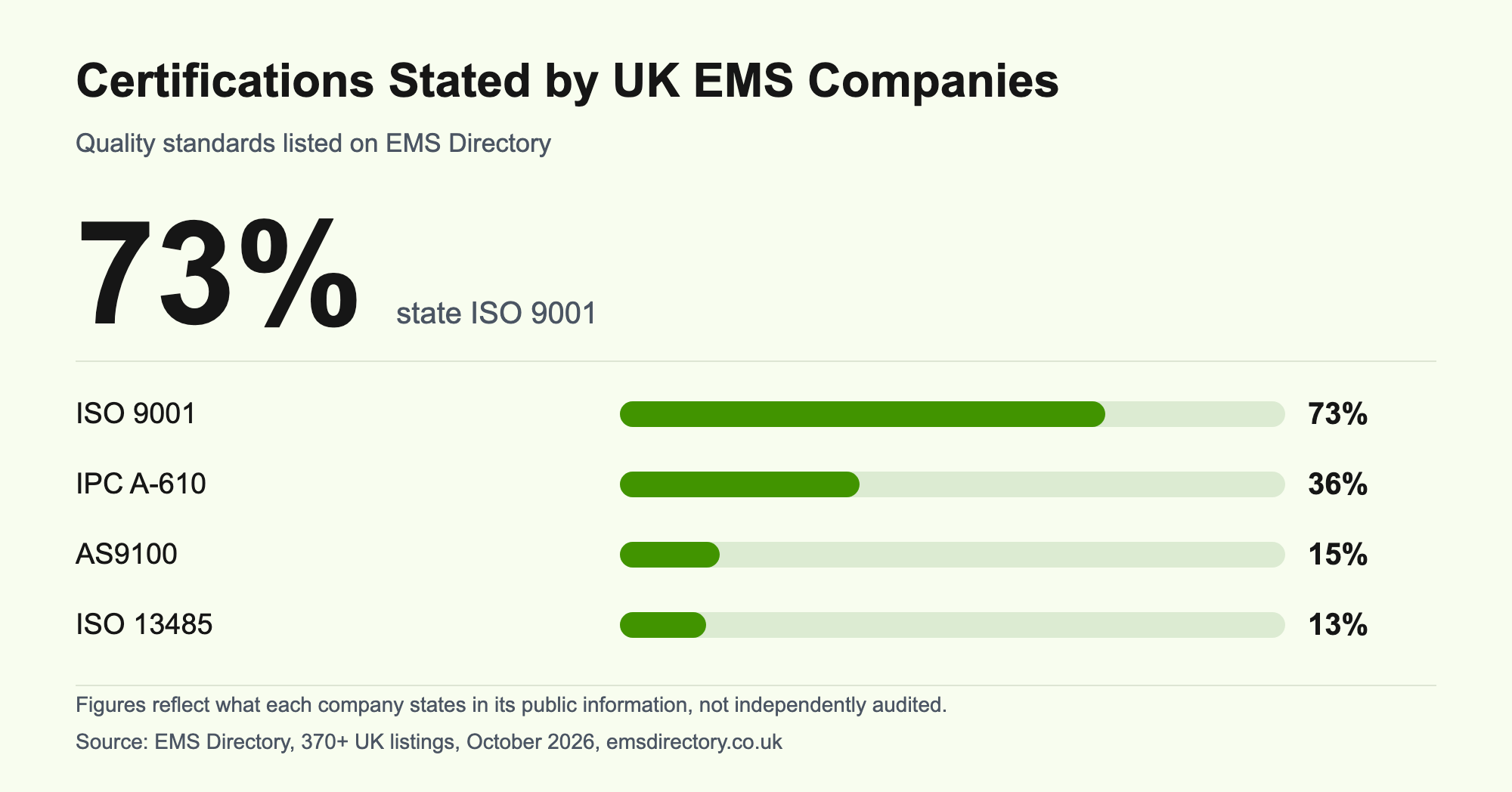
You can see it in the supplier base. Of the 370+ UK companies listed on EMS Directory, 57% list aerospace and defence among the industries they supply and 59% list medical. 15% state AS9100, the aerospace quality standard, and 13% state ISO 13485, the medical devices standard. These are EMS Directory figures as of October 2026 and reflect what each company states in its public information; they are not independently audited.
One supplier, from design to finished product. Of the listed companies, 79% offer design, 86% assembly, 73% box build and 68% turnkey PCB assembly, and 64% offer PCB testing. Half (50%) offer cable assembly. For an overseas buyer, one UK partner that can take a design through to a tested, boxed product means fewer hand-offs and fewer cross-border shipments between suppliers.
Testing and inspection built in. Listed companies state automated optical inspection (51%), functional testing (52%), X-ray inspection (28%) and in-circuit testing (20%), so many can test and report on what they build before it ships.
Quality systems you can check. 73% of listed companies state ISO 9001 and 36% state IPC A-610, the workmanship standard for electronic assemblies. The UK Accreditation Service (UKAS) is the UK's national accreditation body, appointed by government, and it assesses the bodies that provide certification, testing, inspection and calibration (UKAS), so you can ask which body issued a supplier's certificate and whether it is UKAS accredited. You can also look up any UK company for free: the Companies House service shows company status, officers, charges, insolvency information and filed documents (GOV.UK).
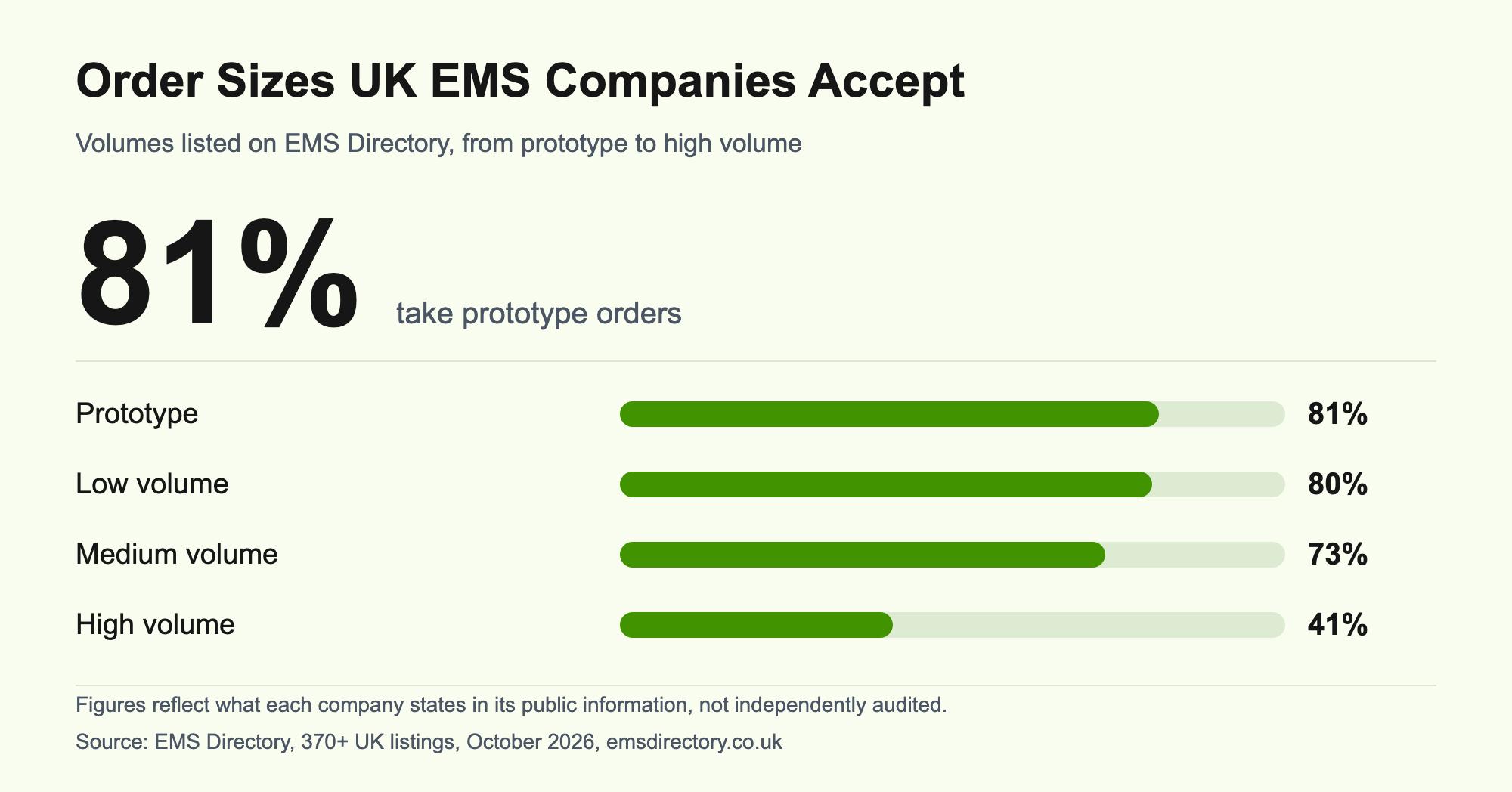
Flexible from prototype to medium volume. On EMS Directory, 81% of companies take prototype orders, 80% low-volume work and 73% medium volume, and 63% take all three, so a product can often move from first prototype to production with the same team. Of the 205 listed companies that state a headcount, 67% have 50 employees or fewer, which means a small, close-working team is the norm. If your plan runs to very large volumes, check capacity early (41% state high-volume capacity).
Preferential access to the EU. Under the EU-UK Trade and Cooperation Agreement, goods that meet the agreement's rules of origin can move between the UK and the EU with zero tariffs (EU Access2Markets). Confirm origin for your own assembly, as set out below.
Easy to work with day to day. English is the working language of UK business. UK time is Greenwich Mean Time in winter and British Summer Time in summer (GOV.UK), so the UK working day overlaps with continental Europe, which is one hour ahead, and with the morning in the US east coast, five hours behind.
Challenges to plan for, and how to manage them
The UK is not a problem-free choice, but each point below is manageable with planning and diligence, and the later sections cover the practical steps.
1. Customs and rules of origin. Zero tariffs apply only to goods that meet the agreement's rules of origin, so an assembly built mainly from parts sourced outside the UK and EU needs checking, not assuming (EU Access2Markets). How to manage it: ask the supplier to confirm in writing whether your assembly qualifies as UK-origin, agree who issues the statement of origin and who files customs declarations under your Incoterm, and confirm duty and import VAT with your customs broker. If you are outside the EU, check your own country's origin rules.
2. Product marking. For the Great Britain market, the UK government continues to recognise the CE marking alongside or in place of UKCA where product regulations meet UK needs (GOV.UK, updated 21 August 2026). The rules of the market where you sell still decide what your product must carry. How to manage it: state the required marking and declaration of conformity in your purchase order, and agree who holds the technical file.
3. Export controls for defence and dual-use work. Items specially designed or modified for military use, dual-use items and items under trade sanctions may need an export licence from the Export Control Joint Unit (business.gov.uk). How to manage it: classify your product against the control list early, give shortlisted suppliers the end use and destination in the RFQ, and allow time for a licence in the schedule.
4. Supplier size and resilience. Many UK suppliers are small teams, so capacity and finances are worth checking. How to manage it: use the free Companies House service, ask for financial references and a capacity plan for your volumes, and for critical products qualify a second source.
5. Volumes and currency. If your volumes are very high, confirm capacity early. Quotes in sterling carry exchange-rate risk. How to manage it: ask for quotes at your real volume breaks, compare total landed cost (unit price, freight, duty, currency and stock held), and ask for quotes in your own currency or agree a rate-review clause.
Start with the quality system and the standard
Ask which certifications the supplier holds and which standard they build to. The chart below shows how often listed companies state each of these. Match the certification to your sector: AS9100 for aerospace and defence, ISO 13485 for medical devices, IATF 16949 for automotive. Our certification and capability checklist explains each one and what to ask beyond the certificate.
Match the supplier to your volume
UK suppliers range from prototype specialists to high-volume production lines. The chart below shows how many listed companies take each order size. If you plan to move from prototype to production, filter on both ends of your range and ask how the same team handles that step.
Agree who handles export and shipping
Ask whether the supplier regularly ships to your country, who prepares the export documents, and which Incoterm applies. Incoterms (such as EXW, FCA, DAP and DDP) set who pays for freight and insurance and when risk passes to you. Agreeing one in writing before you place an order avoids the most common surprises on a first shipment. Duties and import rules depend on your own country, so confirm them with your customs broker.
Plan for time zones and communication
Ask who your single point of contact will be, how quickly they reply to engineering questions, and whether they are happy to work in your time zone for key calls. A clear contact for each programme matters more at a distance.
Protect your design
Agree an NDA before you share drawings or bills of materials, and ask how files are stored and who has access. Ask whether the supplier is used to working under customer IP terms, and how they handle returned or surplus components.
Decide how components are sourced
Turnkey, consigned and hybrid sourcing each suit different projects, and our guide to turnkey, consigned and hybrid component sourcing covers the trade-offs. On EMS Directory, 73% of the suppliers in the Box Build Assembly category list turnkey (full supply), and many list more than one model. For overseas buyers, think about which components you are best placed to supply yourself and how they will cross the border.
Visit or verify when it matters
A first article inspection, a facility visit, or a second pair of eyes on site can settle a decision that documents cannot. If you cannot travel, our on-site support service for OEMs and buyers covers supplier selection, NPI and first article inspection.
Quick-reference checklist
- Match certification to your sector and ask for recent examples
- Confirm the volume range the supplier handles at both ends
- Agree an Incoterm and who prepares export documents
- Name a single point of contact and agree reply times
- Sign an NDA before sharing designs
- Decide the component sourcing model and what crosses the border
- Arrange a first article inspection or a site visit
Figures come from EMS Directory listings as of October 2026 and reflect what each company states in its public information. They are not independently audited.
This guide is general information, not legal or customs advice.
Where to go for more
IPC publishes the workmanship standards referenced above. UKAS is the UK's national accreditation body, a useful check on who issued a supplier's certificates. The International Chamber of Commerce publishes the Incoterms rules.
References
- World Intellectual Property Organization, Global Innovation Index 2025 (press release, 16 September 2025). https://www.wipo.int/pressroom/en/articles/2025/article_0009.html
- US Chamber of Commerce Global Innovation Policy Center, International IP Index 2025, 13th edition (15 April 2025). https://uschamber.com/intellectual-property/2025-ip-index
- US International Trade Administration, United Kingdom Country Commercial Guide: Aerospace and Defense (page updated 30 January 2026). https://www.trade.gov/country-commercial-guides/united-kingdom-aerospace-and-defense
- ADS Group, Value of aerospace, defence, security and space to the UK grew two thirds since 2015 (9 July 2026). https://www.adsgroup.org.uk/knowledge/value-of-aerospace-defence-security-and-space-to-the-uk-grew-two-thirds-since-2015-ads-finds/
- Office for Life Sciences, Bioscience and health technology sector statistics 2023 to 2024 (2 October 2025). https://www.gov.uk/government/statistics/bioscience-and-health-technology-sector-statistics-2023-to-2024/bioscience-and-health-technology-sector-statistics-2023-to-2024
- European Commission, Access2Markets, EU-UK Trade and Cooperation Agreement (tariffs, rules of origin, statement on origin). https://trade.ec.europa.eu/access-to-markets/en/content/eu-uk-trade-and-cooperation-agreement
- GOV.UK, Using the UKCA marking (last updated 21 August 2026). https://www.gov.uk/guidance/using-the-ukca-marking
- UK Government, business.gov.uk, UK export controls and licensing. https://www.business.gov.uk/support/trade-restrictions-regulations-and-licensing/uk-export-controls-licensing/
- GOV.UK, Get information about a company (Companies House). https://www.gov.uk/get-information-about-a-company
- GOV.UK, When do the clocks change? https://www.gov.uk/when-do-the-clocks-change
- Cambridge Industrial Innovation Policy, Industrial performance: UK electronics and electrical equipment manufacturing sectors, UK Innovation Report 2026 (page undated; copyright 2026). https://www.ciip.group.cam.ac.uk/?p=2999
- UK Accreditation Service, About UKAS (page © 2026). https://www.ukas.com/about/
- EMS Directory listings, October 2026 (company-stated information; not independently audited). emsdirectory.co.uk
Shortlist UK suppliers on EMS Directory
Browse UK PCB assembly, box build and electromechanical assembly suppliers and narrow them with the Certifications, Testing, Industries Supported and Order Type / Volume filters. Save the suppliers that fit to your shortlist, open the Compare view to see their certifications and capabilities side by side, and send one enquiry to your whole shortlist at once.
Listing figures in this article are drawn from EMS Directory's own dataset of UK electronics manufacturing listings, and may be cited with attribution to EMS Directory and a link to this article. Other figures are cited to their sources. For press enquiries or a custom data cut, contact ems@emsdirectory.co.uk.