Choosing a UK contract electronics manufacturer is about more than price or lead time. It's about matching a supplier's real process capability and quality system to what your project actually needs. A clear checklist makes that comparison easier, whether you're qualifying a new supplier for the first time or reviewing an existing relationship for an upcoming programme. This guide works through the certifications worth knowing, the process and testing detail that actually separates suppliers in practice, and the questions worth asking before you commit a production run to anyone.
Start with the baseline certifications
ISO 9001 is the starting point for any credible UK EMS provider: it demonstrates a documented, audited quality management system, not good intentions alone. IPC-A-610 (workmanship standards) and IPC J-STD-001 (soldering requirements) sit alongside it as the industry's shared language for acceptable build quality, and RoHS compliance should be assumed as standard for anything shipping into the EU or UK market. It's worth confirming which IPC-A-610 class a supplier works to day-to-day: Class 2 covers general electronics, while Class 3, a stricter standard covering things like solder fillet height and component placement tolerance, is typically expected for aerospace, defence and medical work. If your product needs Class 3, ask for recent examples of Class 3 production on similar products. A certificate shows capability, and recent examples show experience. The Certifications filter on EMS Directory includes ISO 9001, IPC A-610, IPC J-STD-001 and RoHS, so you can shortlist on them directly.
Layer on sector-specific requirements
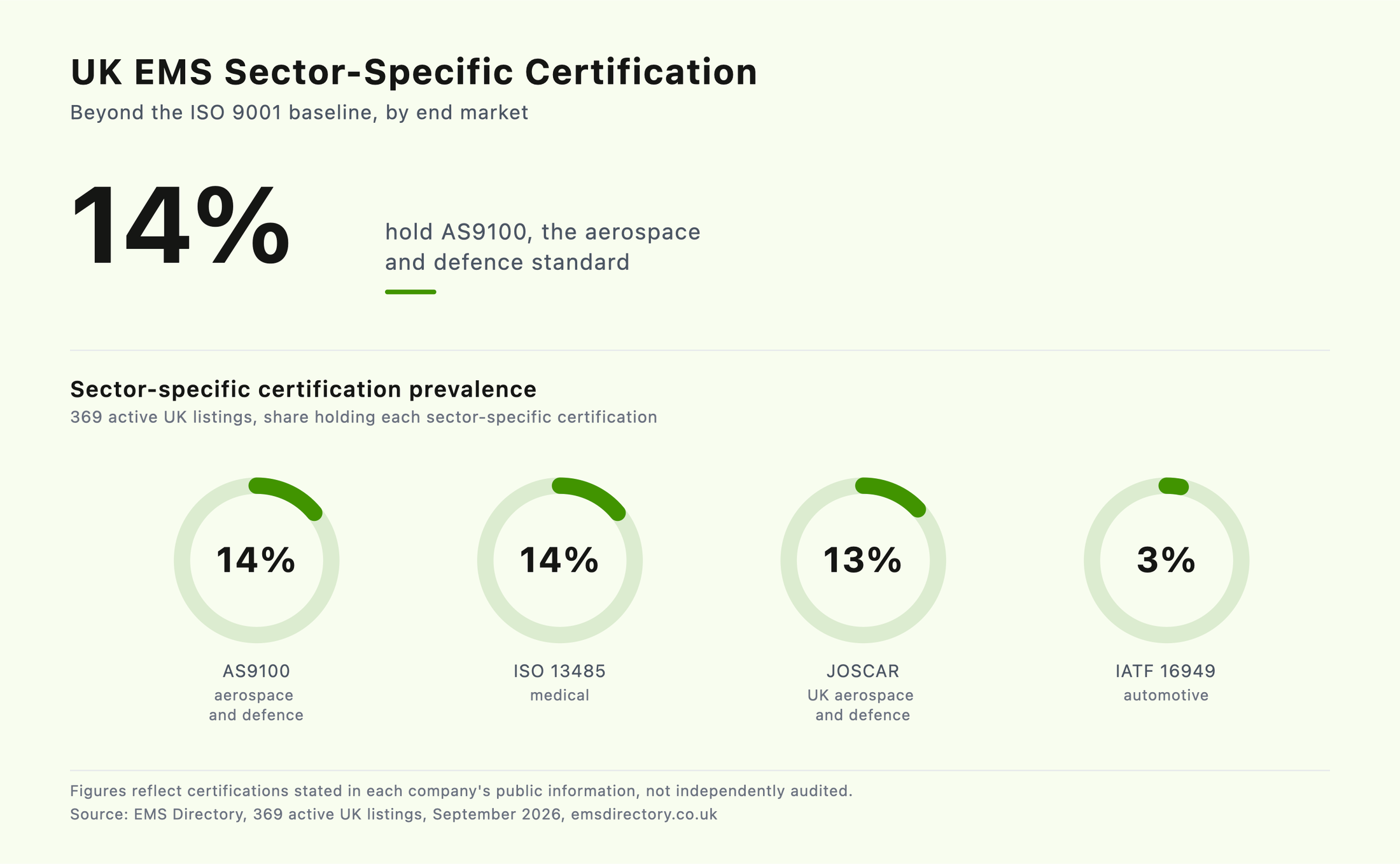
Beyond that baseline, the right certification depends on your end market. AS9100, built on ISO 9001 with additional aerospace-specific requirements around traceability and configuration control, matters for aerospace and defence work, often alongside ITAR registration where a product touches export-controlled technology. ISO 13485 is the medical-device equivalent, with its own requirements around risk management and design controls, and IATF 16949 serves the same role in automotive. ISO 14001 (environmental management) and ISO 45001 (occupational health and safety) are worth noting too: not usually a hard requirement, but increasingly asked for by larger OEM customers as part of their own supply-chain due diligence. None of these replace ISO 9001. They build on it, so look for the specific combination that matches your sector rather than treating any single certificate as sufficient proof on its own. Each of these is a Certifications filter on EMS Directory, and you can combine them with the Industries Supported filter to match your end market.
Testing and inspection depth: the part a certificate doesn't tell you
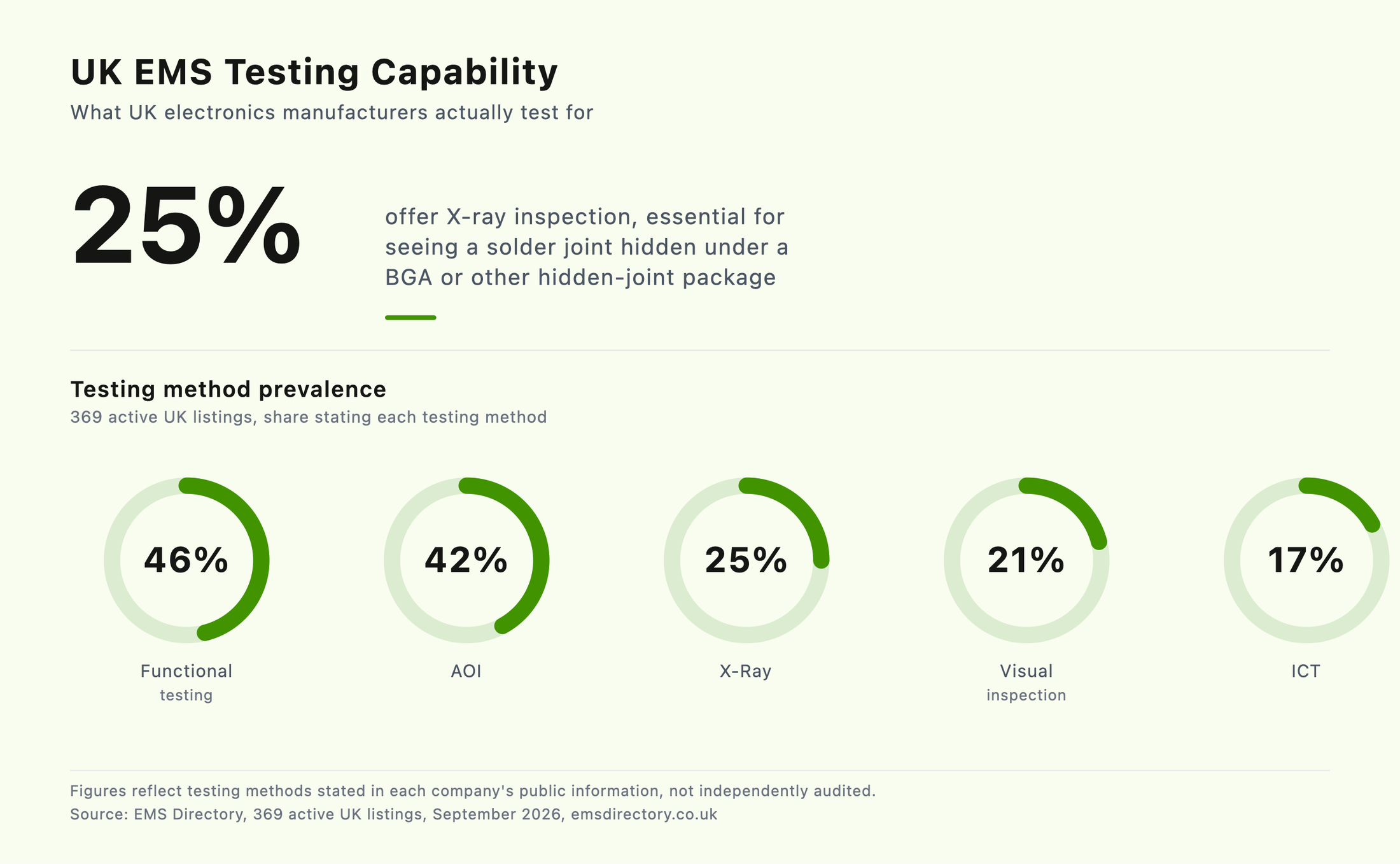
Two suppliers can hold identical certifications and still have meaningfully different testing capability, because a certificate confirms a quality system exists, not which specific inspection methods a given production line actually runs. Automated optical inspection (AOI) is close to universal at this point, though it's limited to what's visible on the surface. For boards with BGA, QFN or other hidden-joint packages, X-ray inspection is the way to actually see the solder joint underneath the component, worth asking for directly if your design uses these package types, since not every supplier who quotes "full inspection" runs it as standard. In-circuit testing (ICT) and flying probe testing catch electrical faults AOI can't (opens, shorts, wrong component values), and functional testing verifies the assembled board actually does what it's meant to do under realistic conditions, the closest thing to proving the product works, as opposed to proving it was built correctly. For safety-critical or high-reliability work, ask specifically what's not covered by a supplier's standard test plan, not what is: the gaps matter more than the headline list. On EMS Directory, the Testing filter includes AOI, X-ray inspection, in-circuit testing, flying probe testing and functional testing, and the Package Type filter includes BGA and QFN, so you can find suppliers who list both.
Component sourcing and supply-chain risk
How a supplier sources components affects both cost and risk, and it's worth understanding the model before you commit rather than discovering it mid-programme. Turnkey sourcing (the manufacturer buys everything) shifts supply-chain risk onto the supplier and is usually simplest for the buyer, but makes you dependent on their supplier relationships and component substitution decisions. Consigned sourcing (you supply the components) gives you full control over exactly what's used, at the cost of taking on the sourcing and logistics work yourself. Hybrid arrangements split the difference: commonly the buyer sources long-lead or high-risk parts while the manufacturer handles the rest. The Component Sourcing / Procurement Model filter lists turnkey, consignment, kitted and hybrid arrangements, so you can start with suppliers who work the way you want to. Whichever model you use, ask how a supplier handles component obsolescence and counterfeit-part risk: independent distributor purchases should be screened against standards like AS6081 or IDEA-STD-1010, and a clear answer on this matters most on any programme with a multi-year production life. Our guide to turnkey, consigned and hybrid sourcing covers the three models in more detail.
Facility and process signals worth asking about directly
Beyond certificates and test lists, a handful of concrete facility questions tend to separate suppliers fast: how many SMT lines they run and whether they're dual-sided in one pass or require a second pass, whether ESD control runs as a documented programme (wrist straps, grounded workstations, humidity control), and whether cleanroom or controlled-environment assembly is available if your product needs it. None of these show up on a certificate, but they directly affect throughput, consistency and whether a supplier can actually deliver the volume and quality your project needs, worth asking to see rather than hear described, ideally via photos or a facility visit before a first production order. Clean room production is one of the Services filters, and Order Type / Volume covers prototype, fast turn, and low, medium and high volume.
Ask what's behind the certificate
A certification tells you what a supplier has committed to and been independently audited against: a genuinely useful signal, not a box-ticking formality. It's still worth asking to see the real substance behind it: how first-article inspection actually works on their line, what corrective action (CAPA) process runs when something doesn't go to plan and how quickly issues actually get closed out, how calibration records are maintained for test and inspection equipment, and whether a finished board can be traced back to its component batch and operator. It's also worth checking the certificate itself: its scope and expiry date should be visible, because certifications cover specific processes and sites rather than a whole company. A supplier with a mature quality system is usually glad to walk through all of this in detail, along with process data, defect rates and reference customers in a similar regulated sector. It's exactly the kind of conversation that helps both sides confirm a genuine fit before committing to a production run.
Quick-reference checklist
- Confirm ISO 9001 plus the IPC-A-610 class (2 or 3) the supplier builds to day-to-day
- Match sector-specific certification to your end market: AS9100/ITAR (aerospace/defence), ISO 13485 (medical), IATF 16949 (automotive)
- Ask what testing methods actually run on your specific package types: AOI alone won't catch a hidden BGA joint fault
- Understand the sourcing model (turnkey, consigned, hybrid) and how obsolescence/counterfeit-part risk is managed
- Ask to see, not hear about, SMT line count, ESD control and any cleanroom capability
- Get specifics on first-article inspection, CAPA turnaround and calibration records
- Check the certificate's scope and expiry date, and ask for traceability records, process data and reference customers in a similar sector
Where to go for more
The certifying bodies themselves are the most reliable source for exactly what each standard covers and requires: IPC publishes the workmanship and soldering standards referenced above and runs recognised training and certification programmes for them, IAQG maintains AS9100 for the aerospace sector, and ISO covers ISO 9001, 13485 and 14001 directly. UKAS, the UK's national accreditation body, is a useful independent check on whether a certificate was actually issued by a properly accredited body in the first place, and IDEA sets the independent-distributor inspection standards referenced above for counterfeit-part risk.
Let the EMS Directory filters do the first pass
Most of the checks above can be made on EMS Directory without opening a dozen separate company websites. Listings use the same structured fields, so the filters narrow the field for you:
- Certifications: ISO 9001, IPC A-610, IPC J-STD-001, RoHS, AS9100, ITAR, ISO 13485, IATF 16949, ISO 14001, ISO 45001
- Testing: AOI, X-ray inspection, in-circuit testing, flying probe testing, functional testing
- Package Type: BGA, QFN and other hidden-joint packages, to combine with the Testing filter
- Component Sourcing / Procurement Model: turnkey, consignment, kitted, hybrid
- Order Type / Volume: prototype, fast turn, low, medium and high volume
- Industries Supported: aerospace and defence, medical, automotive and more
- Services: includes clean room production
Combine them to match your project. For a defence board with hidden-joint packages, for example, you might filter for AS9100, X-ray inspection and BGA. Then save the suppliers that fit to your shortlist, open the Compare view to see their certifications and capabilities side by side, and send one enquiry to your whole shortlist at once.
Start from the service you need: PCB Assembly, Box Build Assembly, Electromechanical Assembly, Cable & Wire Assembly or PCB Fabrication.
A few points still need a conversation with the supplier: CAPA turnaround, calibration records, traceability and a facility visit. The filters mean you're having those conversations with the right suppliers.
If you'd like on-site support with a supplier decision, NPI or first article inspection, Eyes on the Ground is our on-site service for OEMs and buyers.