
Two suppliers can quote the same board and mean two different things by "we'll build it." Component sourcing model, turnkey, consigned, or hybrid, shapes cost, lead time and supply-chain risk as much as the assembly process itself, and it's worth deciding deliberately rather than defaulting to whatever a supplier proposes first.
Turnkey: the supplier sources everything
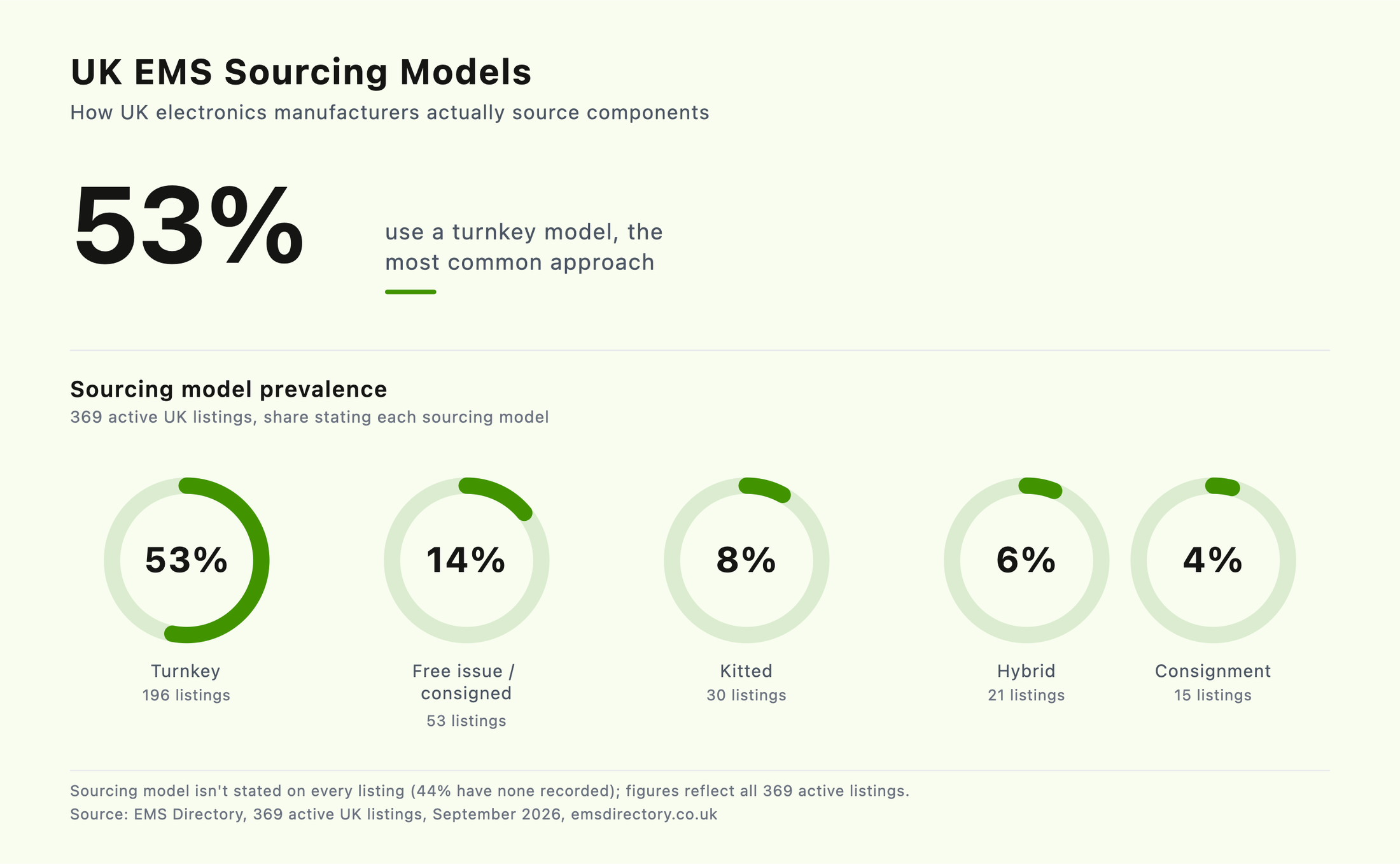
In a turnkey arrangement, your contract manufacturer buys every component on the bill of materials, using their own supplier relationships and purchasing power. For most projects this means fewer suppliers for you to manage day to day, and it can mean better pricing on higher-volume parts, since the manufacturer is often buying at greater scale than a single customer could alone. The trade-off is less direct visibility into exactly where components originate, and less personal control if a part needs substituting during a shortage, a reasonable trade for many projects, but worth weighing consciously if traceability to a specific approved-vendor list genuinely matters for your product or your end customer's requirements.
Consigned: you supply the parts
Under a consigned model, you source and ship the components yourself, and the manufacturer supplies labour, process and equipment against your parts. This gives you full control over exactly where components come from, useful if you already have strong supplier relationships, need specific component traceability for a regulated product, or are managing a shortage-prone part directly through your own channels. It does mean you're carrying the sourcing risk and the administrative load of getting the right parts to the right place at the right time, which is a real ongoing commitment, not a one-off task.
Hybrid: a split that matches real-world sourcing
Most projects don't fit neatly into either extreme, which is exactly why hybrid arrangements are common in practice. A hybrid model lets you supply the components that matter most to control directly, a custom, long-lead-time or sole-sourced part, say, while the manufacturer sources everything else through their own established supply chain. It's genuinely worth asking any prospective supplier which model they prefer to run, rather than assuming every EMS company is equally set up for all three: sourcing systems, supplier relationships and internal processes differ meaningfully between them, and a supplier who mostly runs turnkey work may handle a consigned request quite differently in practice.
Mixing models across a product's lifecycle
The right model can also change as a product moves from prototype through to volume production. A low-volume prototype run might run consigned, with you sourcing scarce or long-lead-time parts directly to keep the schedule moving, while the same product's high-volume production run shifts to turnkey once the bill of materials has stabilised and the manufacturer's own purchasing scale starts to outweigh the value of direct control. Flagging this upfront, rather than assuming one model will suit the whole programme, saves a renegotiation later.
Where to go for more
CIPS, the Chartered Institute of Procurement & Supply, offers UK-recognised training and qualifications in supply chain and sourcing strategy if this is a decision your team wants to build lasting internal capability around, rather than treating it as a one-off judgement call for a single project.
How EMS Directory helps
Knowing which sourcing model you want makes for a far more productive first conversation with a supplier, and EMS Directory's filters let you narrow by order volume and industry experience before you even get there. Save a shortlist of UK manufacturers worth talking to, compare their certifications and capabilities side by side, and send one enquiry, including which sourcing model you're after, to your whole shortlist at once from the Compare view.
Browse suppliers by service: PCB Assembly, Box Build Assembly and Cable & Wire Assembly. Our certification and capability checklist covers what to ask next.
Note for publishers and journalists
Figures and data in this article are drawn from EMS Directory's own dataset of UK electronics manufacturing listings, and may be cited with attribution to EMS Directory and a link to this article. For press enquiries or a custom data cut, contact ems@emsdirectory.co.uk.