

Ask ten people in UK electronics sourcing to define "CEM" versus "EMS" and you'll get ten answers that mostly agree in theory and diverge in practice. Rather than add an eleventh definition, we pulled the actual service data behind the 369 active UK listings on EMS Directory to see what the distinction looks like in the real market.
The theory, briefly
A Contract Electronics Manufacturer (CEM) describes the company itself: whoever builds and tests a product to a customer's own design, on a contract basis. Electronics Manufacturing Services (EMS) describes the breadth of what a provider offers across a product's life: design input, prototyping, component sourcing, production, and support once a product has shipped. A CEM doing pure build-to-print PCB assembly covers one slice of what "EMS" as a category means; a full-service EMS provider covers considerably more. In practice, most UK companies use both terms about themselves without much distinction, which is exactly why the definitions alone aren't that useful when you're actually trying to source a supplier.
What the data actually shows
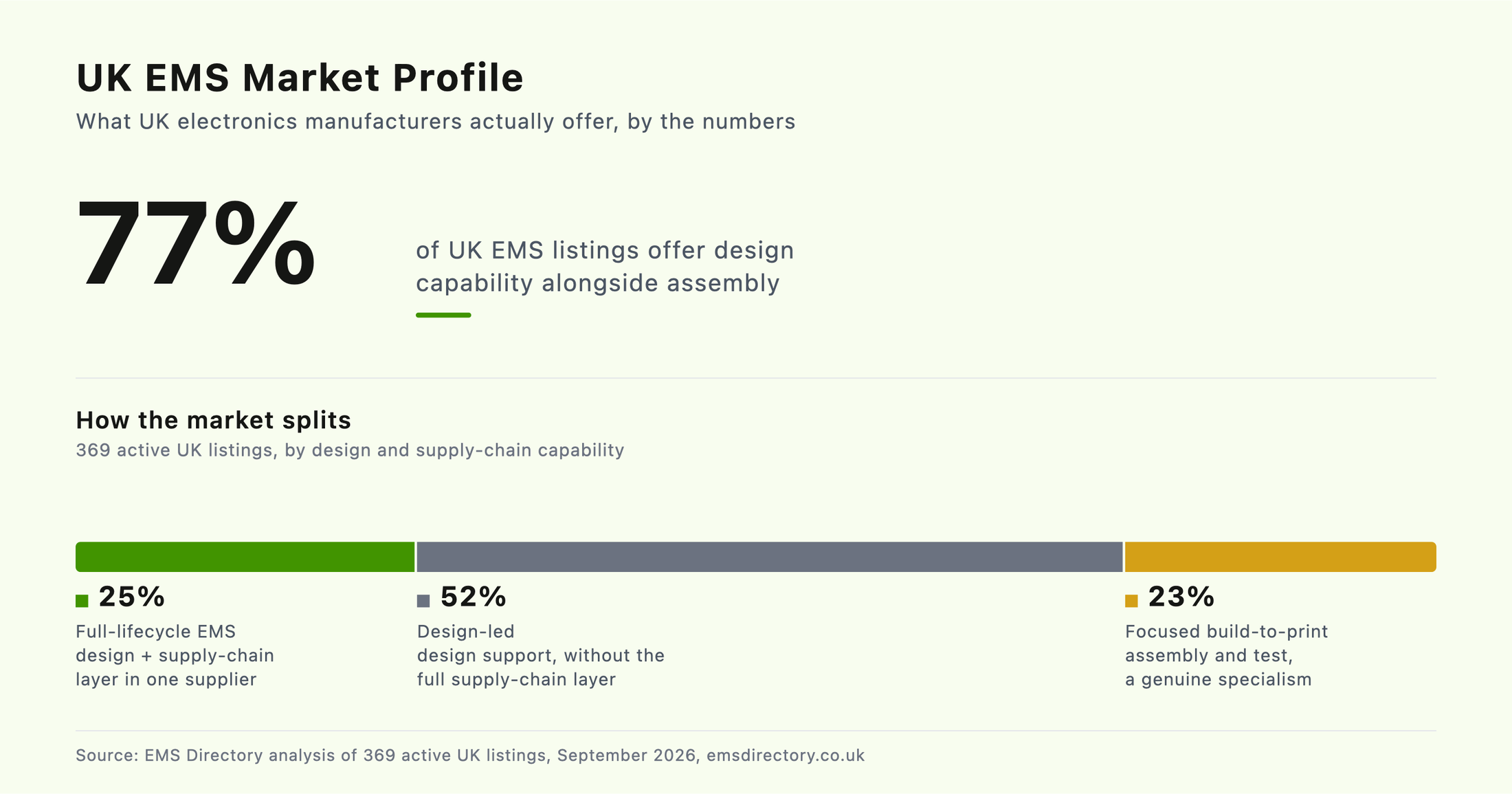
The headline finding is a genuine strength: 285 of the 369 active UK listings on EMS Directory, 77%, offer design capability alongside assembly. That's real evidence the UK market has broadly moved past pure build-to-print, and it means most suppliers here can pick up a project well before a finished, approved design exists.
Beyond that, a smaller and more specific group has built out the supply-chain layer that defines a genuinely full-lifecycle provider: material management, logistics/distribution, or obsolescence management. 118 listings, 32%, offer at least one of the three, and 34, 9%, offer obsolescence management specifically, arguably the clearest marker of a provider managing a product across its whole working life. This is a specialised, deliberately-built capability, not a default, so knowing which suppliers hold it is genuinely useful when a project needs it.
Combine both markers (design capability plus at least one supply-chain or lifecycle service) and 93 listings, 25%, fit a full-lifecycle EMS profile: design through to in-service support, in one supplier. At the other end, 84 listings, 23%, are focused build-to-print specialists: assembly and test without the broader design or supply-chain layer, which is a real, valuable position in its own right, not a lesser one, especially for a project that already has a finished design and needs it built well.
The largest group, 192 listings, 52%, sits between the two: real design support alongside assembly, without the full supply-chain layer a large OEM programme might need.
Does company size predict which type a supplier is?
Partly, based on the listings where headcount is stated; it isn't on every listing, so these figures reflect what's known. Among full-lifecycle providers with a known headcount, around 80% employ 11 or more people, with real representation in the 51-200 and 201-500+ bands and one provider above 500. Among the focused build-to-print group with a known headcount, most employ fewer than 50 people, and none reach above 200. The pattern makes intuitive sense: running dedicated material management, logistics or obsolescence-management functions takes headcount that a smaller, assembly-focused shop hasn't needed to build out. Smaller full-lifecycle providers and larger focused-assembly specialists both exist in the data.
What this means if you're sourcing
The practical takeaway isn't "look for EMS, avoid CEM." With design capability now offered by more than three-quarters of UK suppliers, most companies here can support a project earlier than a CEM label alone would suggest. What "we do design" won't tell you on its own is whether a supplier also runs the supply-chain layer, material management, logistics, obsolescence management, that a longer-running or more complex programme needs. That's the detail genuinely worth checking for.
If your project is a build-to-print job with a finished design and an approved component list, a focused assembly specialist, the 23% here, is often exactly what you need, built for speed and cost rather than carrying lifecycle services you won't use. If you're starting from a rough concept, need ongoing support through component shortages, or expect the product to run in the field for years needing spares and revisions, a full-lifecycle provider or a box build or systems integration specialist is often the better starting filter than PCB assembly alone. Either way, the UK market has strong options at both ends: it's a question of matching a supplier's real profile to your project.
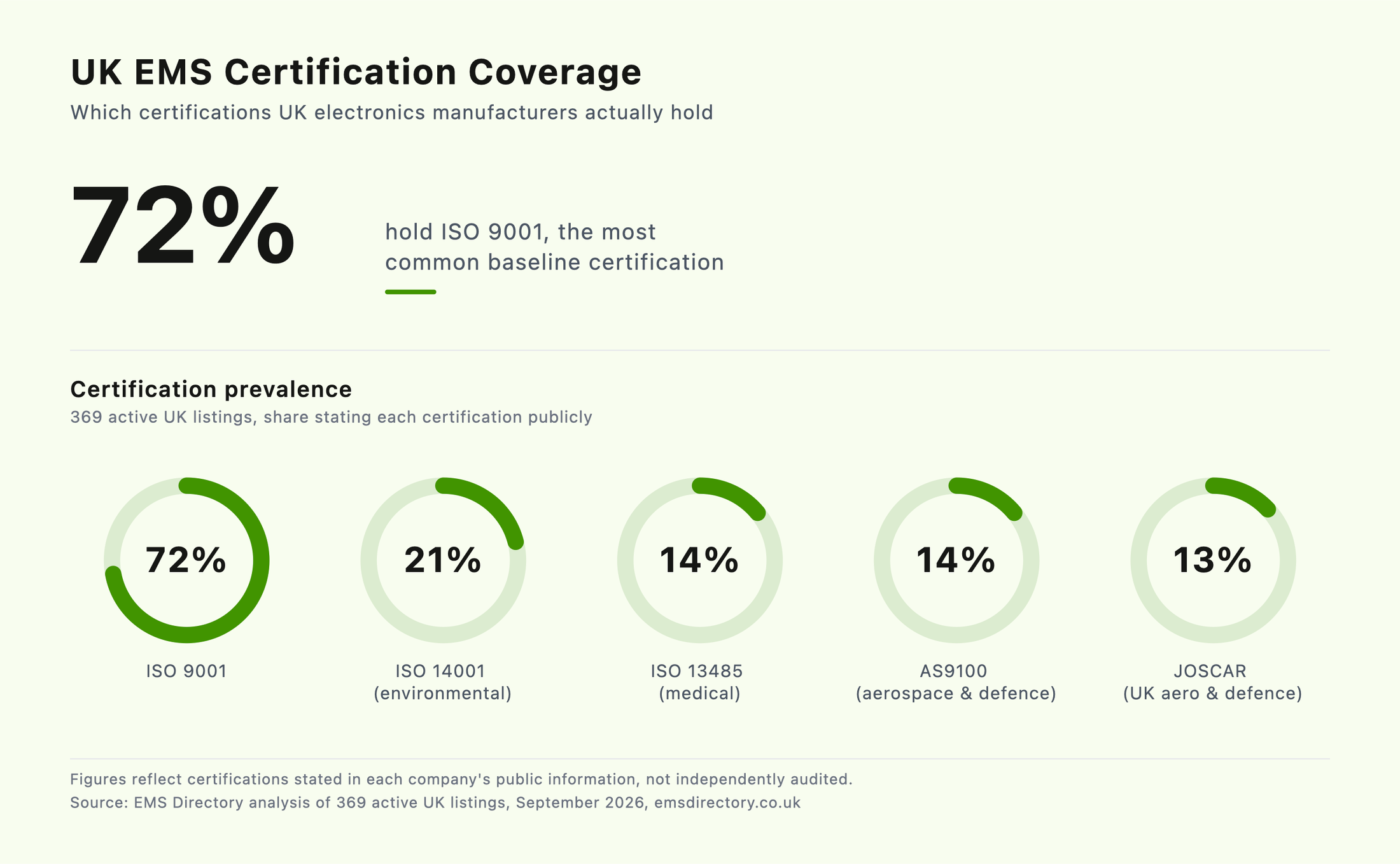
Certifications sit on a separate axis entirely. In the UK specifically, ISO 9001 is the baseline, but the detail that actually separates suppliers is what sits alongside it: which IPC-A-610 class a supplier builds to day-to-day (Class 2 for general electronics, Class 3 for aerospace, defence and medical), JOSCAR registration for UK aerospace and defence supply chains, ITAR where a product touches export-controlled technology, ISO 13485 for medical devices, and IATF 16949 for automotive. A focused assembly shop can hold exactly the certification your regulated product needs; a full-lifecycle provider can lack it. Checking services and certifications separately, rather than assuming one implies the other, is worth doing every time. Component sourcing model, turnkey, consigned or a hybrid split, is a related but distinct question again.
Where to go for more
IPC publishes the workmanship standards and industry terminology referenced across contract electronics manufacturing, and Make UK tracks the wider UK manufacturing and supply-chain landscape these figures sit within.
How EMS Directory helps
This is exactly the detail a CEM or EMS label alone can't give you. Every listing on EMS Directory captures the actual services a company offers, design, assembly, box build, testing, and the specific lifecycle and procurement services covered above, alongside certifications, board and process capability, order volume and industries served. Filter for the combination your project genuinely needs rather than a label, shortlist the suppliers that match, compare them side by side, and send one enquiry to your whole shortlist at once.
Note for publishers and journalists
Figures and data in this article are drawn from EMS Directory's own dataset of UK electronics manufacturing listings, and may be cited with attribution to EMS Directory and a link to this article. For press enquiries or a custom data cut, contact ems@emsdirectory.co.uk.